Bocco vs MyFitnessPal: an honest comparison
By the Bocco team · 5 min read
The short version: MyFitnessPal and Bocco solve the same problem — knowing what you ate — in opposite ways. MyFitnessPal has you search or scan a barcode against a food database it's been building since 2005 (millions of entries, crowdsourced by users). Bocco skips the search bar: you take a photo, it reads the plate, and you correct it in a sentence if it's off. Neither is "the better app" — they're built around a different verb. One is search. The other is snap.
I used MyFitnessPal for years before this, and it earned its size — the database really is huge, and for anyone who already knows nutrition labels and portion math, typing it in works fine. What always slowed me down was scrolling past three near-identical "chicken breast, grilled" entries trying to guess which one matched what was actually on my plate. What's also changed since then is the free tier, and that's worth knowing before you pick either one.
MyFitnessPal, in one line
The giant of the category. Launched in 2005, it's logged more meals than almost anyone, and its crowdsourced database covers restaurant chains, packaged goods, and home recipes other apps just don't have yet. If you want depth of coverage, MyFitnessPal has it.
The real difference: search-and-log vs snap-and-correct
Open MyFitnessPal and the first thing you do is type — "grilled chicken breast," pick the closest match from a list of near-duplicates, adjust the serving size, repeat for every item on the plate. It's fast once you're fluent in it, and the barcode scanner speeds up packaged food. But it asks you to find the right entry in someone else's database, which means the accuracy of your log depends on how carefully you (and whoever originally submitted that entry) did the matching.
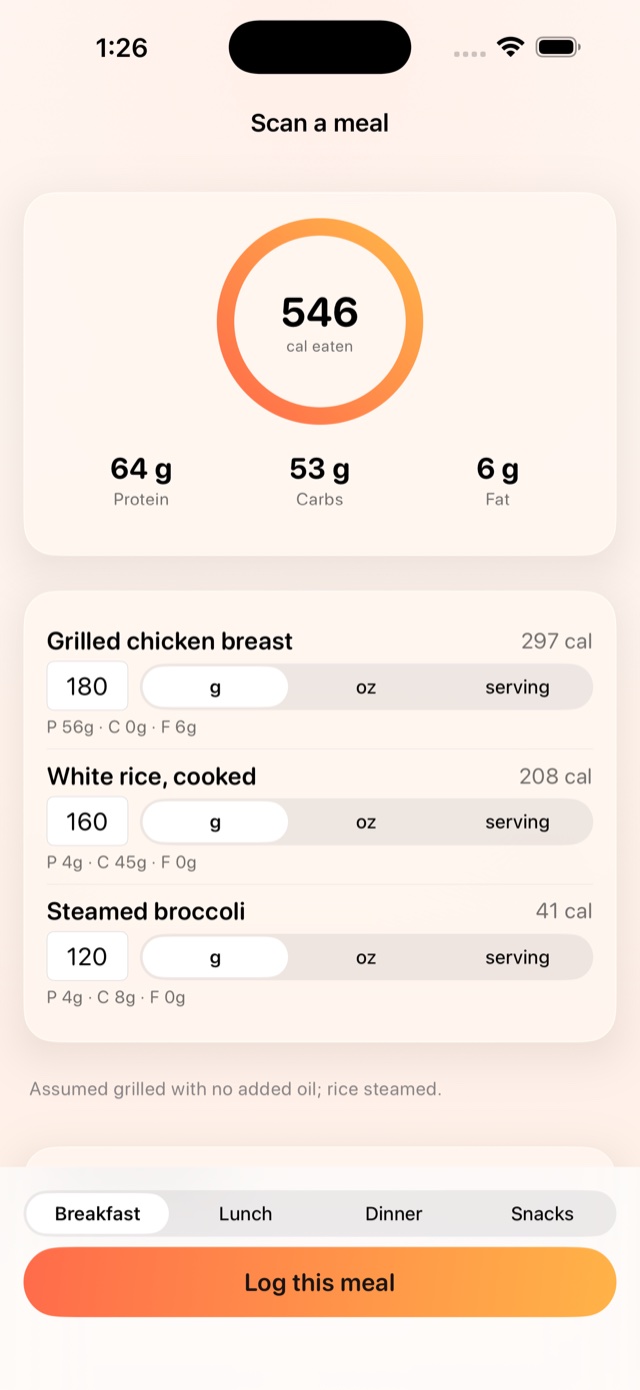
Bocco starts from a photo instead. You snap the plate, it estimates the items, grams, and calories in one pass, and if a portion looks off — bigger bowl, extra oil, a different cut of meat — you just say so in plain words and the numbers recalculate. No searching a list of "chicken breast, grilled" vs "chicken breast, grilled, skin removed" vs "chicken breast (grilled)" to find the one that matches what's actually on your plate.
Neither method is free of error. They're just different kinds of work: MyFitnessPal's is mostly upfront (typing, matching), Bocco's is mostly at the correction step (telling it what it got wrong).
What MyFitnessPal's free tier actually gives you now
This is the part that's genuinely changed and worth knowing before you commit: MyFitnessPal's free tier now caps you at 5 food entries a day, shows ads throughout the app, and puts the barcode scanner — previously free since launch — behind a Premium subscription at $79.99/year (or $19.99/month), according to MyFitnessPal's own pricing page. For anyone logging three meals plus a snack or two, that 5-entry cap is gone by early afternoon.
That's not a knock — every app has to make money somehow, and MyFitnessPal's database costs real money to maintain. But it means "free" doesn't mean quite what it used to, and it's fair to factor that into the comparison.
Accuracy: a genuinely mixed picture for both
MyFitnessPal's database held up well in a 2020 peer-reviewed validation study: researchers found it accurate for total energy intake, macronutrients, sugar, and fiber when checked against a reference dietary-assessment method — but not for sodium and cholesterol, which the crowdsourced entries tend to get wrong more often (Evenepoel et al., Journal of Medical Internet Research, 2020). So for the numbers most people actually track — calories, protein, carbs, fat — it's a solid tool, as long as you pick the right entry.
MyFitnessPal has also added its own AI photo option, Meal Scan, built with Passio.ai — but it's a Premium/Premium+ add-on layered on top of a database-first app, not the main way most people use it. Bocco is built the other way around: the photo is the starting point, not an upsell, and every estimate is honest about being an estimate — you're expected to correct it, not trust it blindly.
Which should you pick?
- MyFitnessPal if you want the deepest food database in the category and don't mind typing or paying to unlock barcode scanning and full macro tracking.
- Bocco if you'd rather skip the search bar entirely and log by photo, correcting in plain words when it's off.
Frequently asked questions
Is MyFitnessPal still free?
There's a free tier, but since late 2022 it caps you at 5 food entries a day, shows ads, and puts the barcode scanner behind Premium ($79.99/year).
Is Bocco a good MyFitnessPal alternative?
If you want to log by photo instead of searching a database, yes — that's the actual difference, not a claim that one app is better than the other.
Is MyFitnessPal's database accurate?
A 2020 peer-reviewed study found it accurate for calories, macros, sugar, and fiber against a reference method, but not for sodium and cholesterol.
Does MyFitnessPal have AI photo logging too?
Yes — Meal Scan, built with Passio.ai — but it's a paid add-on on top of a database-first app, not the primary way you log.
Which has the bigger food database?
MyFitnessPal, by a wide margin — it's been crowdsourcing entries since 2005. Bocco isn't trying to compete on database size; it reads your plate directly instead.
Related: Bocco vs Cal AI · How accurate is AI calorie counting?